
This article has been independently fact-checked against primary sources, including National Electrical Code requirements, California building permit regulations, and the Davis-Stirling Common Interest Development Act. All claims are sourced and verified as of February 2026.
When an HOA board hires a contractor to replace electrical panels across a 100-unit community, they are not buying a larger version of a single-panel replacement. They are buying an entirely different kind of service — one that requires project management infrastructure, supply chain capability, utility coordination, permit administration, and homeowner communication systems that have nothing to do with the technical act of swapping a panel.
Most electrical contractors cannot provide that service. Not because they lack technical skill, but because they lack the operational infrastructure that community-scale work requires. A licensed electrician who delivers excellent work on individual service calls is genuinely not equipped to manage a 100-unit HOA project. The skill sets are different. The systems are different. The failure modes are different.
This article walks through the complete 20-step process Tradesman Electric executes on every community-wide panel replacement project. At each step, we explain what is actually happening operationally — and what happens when that step is managed by a contractor without the right infrastructure.
Why the Process Is the Product
A single-panel replacement is a technical task. A licensed electrician with the right tools and materials can complete it competently in a day. The technical work at the unit level is the same whether the contractor is replacing one panel or one hundred.
What changes at scale is everything surrounding the technical work. Scheduling 100 homeowners across a two-month installation window. Tracking permit status across dozens of addresses simultaneously. Coordinating with Southern California Edison for meter access across multiple service dates. Ensuring that the panel installed in unit 47 meets the same standard as the panel installed in unit 12, three weeks earlier, by a different crew member. Producing a documentation package that satisfies an insurance carrier’s compliance requirements for every single address.
None of this is technical electrical work. All of it determines whether the project succeeds.
The 20-step process below is the operational answer to this challenge. It is not a marketing framework — it is the actual sequence of work that takes a community from initial inquiry to completed project with carrier documentation in hand. Every step exists because skipping it creates a failure downstream.
Phase 1: Assessment and Discovery (Steps 1–5)
Step 1: Initial Needs Assessment and Timeline Determination
Before any site visit, the project team establishes the community’s starting position. How many units? What panel brands have been identified? Has the carrier issued a non-renewal notice, and if so, what is the compliance deadline? Is the board acting proactively or reactively?
These questions determine the project’s pace and structure. A community with a 60-day carrier deadline is managed differently than one acting six months ahead of renewal. The intake conversation sets the project clock.
What a general electrician does instead: Takes the call, quotes a per-panel price, and asks when you want to start. No timeline analysis. No deadline risk assessment. No differentiation between a project that has six months and one that has six weeks.
Step 2: Free Community-Wide Assessment Scheduling
A licensed electrician is scheduled to inspect every unit and common area in the community — not a sample, not a representative cross-section, every unit. The assessment is provided at no charge because accurate project scoping requires complete data. Estimating scope from a partial inspection produces inaccurate proposals and surprises during installation.
Step 3: Comprehensive On-Site Inspection
The inspection team moves through the community systematically. Every panel is opened, identified by brand and model, evaluated for condition, and assessed for secondary concerns — evidence of overheating, amateur modifications, undersized service, access complications, and configuration details that affect the installation scope.
This is where hidden complexity surfaces. At Lakeglen HOA, a 129-unit community in Orange County, the inspection revealed that more than 80 units required access box modifications in addition to panel replacement. That complexity could not have been identified from the street. It required opening every panel in the community.
What a general electrician does instead: Inspects a few units, extrapolates, and discovers the rest during installation — when surprises become delays, change orders, and missed deadlines.
Step 4: Geo-Tagged Photo Documentation of Every Panel
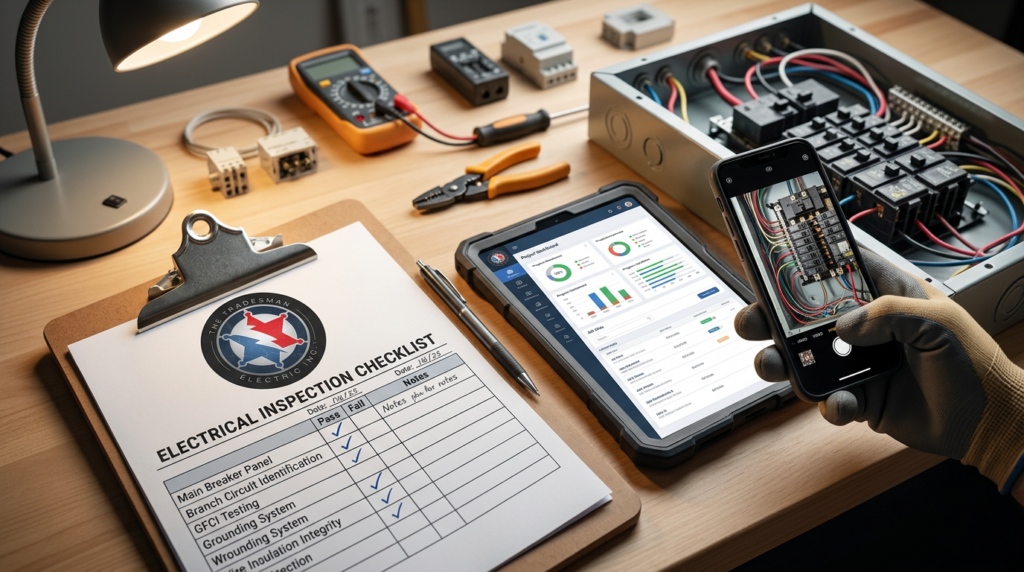
Every panel inspected is photographed with documentation that records the unit address, panel brand, model, condition observations, and timestamp. This is not optional documentation — it is the evidentiary foundation for the insurance carrier’s compliance review, the board’s liability protection, and the project’s baseline record.
The Monday.com project tracking system receives this documentation in real time. Before the inspection team leaves the property, every unit has a digital file with its pre-installation condition recorded.
What a general electrician does instead: Takes some notes. Maybe some photos. No systematic documentation. No digital record organized by address. Nothing the insurance carrier can use.
Step 5: Written Inspection Report with Risk Assessment
Within a defined timeframe after the inspection, the board receives a written report covering every panel in the community — brands, ages, conditions, risk assessment by unit, and a clear distinction between common area panels and homeowner-owned equipment. This report is what the board presents to its insurance carrier, its legal counsel, and its homeowners. It is the factual foundation for every decision that follows.
Phase 2: Planning and Authorization (Steps 6–9)
Step 6: Board Presentation of Findings
The inspection findings are presented at a board meeting with enough operational detail that board members understand the project scope — not just that panels need to be replaced, but what the replacement involves unit by unit, what the timeline looks like, and what the documentation trail will produce at the end.
This presentation is also when the issue gets formally entered into board meeting minutes. That entry is the beginning of the liability protection documentation that board members need throughout the project.
Step 7: Insurance Carrier and Broker Consultation
Armed with the inspection report, the board contacts its insurance broker to confirm exactly what the carrier requires and what documentation will satisfy the compliance conditions. This conversation often reveals whether the community is already on a watchlist and how much runway actually exists before the renewal deadline.
The inspection report produced in Step 5 is the primary document in this conversation. Carriers respond to professional documentation. Boards that arrive at this conversation with a comprehensive written report are treated differently than boards that arrive with verbal descriptions of what their contractor told them.
Step 8: CC&R Review and Responsibility Determination
The CC&Rs determine which panels are the association’s maintenance responsibility and which belong to individual homeowners. This distinction affects funding, legal liability, and project structure. Even when panels are technically homeowner property, centralized project management is almost always the correct approach — because individual homeowner delegation produces inconsistent work, missing permits, and insurance compliance gaps.
Step 9: Legal Counsel Consultation
For projects of this scope, HOA legal counsel reviews the board’s fiduciary obligations, CC&R interpretation, and the documentation requirements that protect board members individually. This step is recommended before the project is formally authorized.
Phase 3: Contractor Selection and Authorization (Steps 10–11)
Step 10: RFP Development and Contractor Outreach
A formal request for proposals goes to qualified contractors. The questions that matter are not primarily about price — they are about operational capability. Does the contractor have a dedicated project coordinator? What project management software do they use? Do they have warehouse capacity to pre-procure materials? How many HOA panel replacement projects have they completed? What does their crew look like? What is their permit track record in this jurisdiction?
These questions are designed to surface the operational infrastructure that separates an HOA specialist from a general electrician. A contractor that cannot answer them specifically and in detail is not equipped for this work regardless of how competitive their per-panel price is.
Step 11: Proposal Review and Board Vote
Proposals are evaluated on the full scope of capability. The board votes, the decision is documented in minutes, and the project is formally authorized.
Tradesman Electric brings specific operational infrastructure to every HOA project: 400-plus panels replaced annually, a 12-person dedicated crew, a full-time project coordinator assigned to each HOA project, a 3,000 square foot warehouse for material pre-procurement, Monday.com project tracking with board-accessible real-time visibility, and a 20-year written workmanship warranty. These are not differentiators in the abstract — they are the specific capabilities that each of the following steps requires.
Phase 4: Financing and Communication (Steps 12–13)
Step 12: Funding Determination and Approval
Reserve funds, special assessment, HOA loan, or phased approach — the funding structure is determined and formally approved through whatever process the CC&Rs require. This step cannot be rushed, and it cannot happen after the contractor is on site. The funding structure must be in place before installation begins.
Step 13: Homeowner Communication Campaign
The communication campaign runs from first notice through project completion. It includes an initial issue notification before any assessment is mentioned, a board decision notice after the contractor is selected, a town hall with full Q&A, unit-by-unit scheduling notices, day-before reminders, and post-completion confirmation for each unit.
This is a dedicated administrative function. At the scale of a 100-unit community, managing homeowner communication is a part-time job. It requires tracking who has been contacted, who has responded, who has rescheduled, and who has not yet confirmed access — across every unit in the community, simultaneously.
At Lakeglen HOA, some units were owned by off-site investors who were difficult to reach. The project coordinator maintained detailed contact logs for every unit and pursued multiple outreach attempts through different channels to ensure that no unit fell through the cracks. That administrative discipline is what keeps a large project on schedule.
What a general electrician does instead: Sends one notice to the HOA office and expects the board to handle homeowner communication. The board — which has other responsibilities and no project management infrastructure — becomes the communication bottleneck. Units are missed. Access is not confirmed. Installation days are wasted.
Phase 5: Procurement and Permitting (Steps 14–16)
Step 14: Permit Applications Submitted
Permit applications go to the local building department as early in the process as possible. Permit timelines vary by jurisdiction. Some cities process applications in two weeks. Others take six. Starting permits late creates a scheduling bottleneck that cascades across the entire installation phase.
An experienced HOA contractor knows the permit timeline for every jurisdiction they work in and builds that timeline into the project schedule from the beginning. They also maintain relationships with local permit offices that allow issues to be resolved quickly when they arise.
What a general electrician does instead: Submits permits when installation is about to start and discovers the jurisdiction has a four-week backlog. The installation schedule is delayed. The carrier deadline gets closer. Pressure mounts.
Step 15: SCE Meter Spot Requests
Southern California Edison requires advance notice for the utility work associated with panel replacements. Lead times for meter spot requests typically run four to eight weeks. This step must be initiated immediately after contractor authorization — not after homeowner communication, not after materials arrive. The SCE lead time has to be built into the project schedule from day one.
Contractors without HOA project experience routinely underestimate this step. The result is a fully staffed crew ready to install panels that cannot be energized because the utility coordination was not initiated early enough.
Step 16: Material Pre-Procurement and Warehousing
Before a single installation is scheduled, every panel, breaker, grounding component, surge protection device, and ancillary material is ordered and received into the warehouse. Every item. For every unit.
Pre-procurement accomplishes three things simultaneously: it locks in current pricing before any supply constraint develops, it eliminates material availability as a scheduling variable, and it allows the installation phase to run at the pace the schedule demands rather than the pace the supply chain permits.
Tradesman Electric’s 3,000 square foot warehouse facility is built for this function. When an HOA project is authorized, the materials for that project are procured and on shelves before installation begins. A crew member who needs a specific breaker for unit 73 does not wait for a delivery. It is already in the warehouse.
What a general electrician does instead: Orders materials as needed. Discovers that the specific breaker configuration required for certain units has a three-week lead time. Installation for those units is rescheduled. The carrier deadline gets closer.
Phase 6: Scheduling and Execution (Steps 17–19)
Step 17: Unit-by-Unit Installation Scheduling
The installation schedule is built unit by unit in the Monday.com project management system. Each unit has a confirmed installation date, a confirmed contact, a confirmed access method, and a note of any special considerations identified during the inspection. The schedule is visible to the board in real time and updated continuously as units are completed and appointments are confirmed or rescheduled.
Every unit receives an advance scheduling notice with a confirmed date and a clear explanation of what to expect — when the crew arrives, when power goes off, when the inspector comes, when power is restored.
The Monday.com system makes the project’s status visible at any moment. The board does not need to call the project coordinator to find out how many units are complete. They can see it. They can see which units are scheduled for the following week. They can see which units still need access confirmation. This visibility is what allows the board to maintain confident oversight without managing logistics themselves.
Step 18: Installation Execution
On installation day, the crew arrives in the morning. Power is off by 8:00 AM. The old panel is removed and the new one is mounted in the same location. All circuits are connected to the new panel, traced, and labeled accurately. AFCI arc-fault and GFCI ground-fault breakers are installed where current code requires. New grounding and bonding connections are installed to National Electrical Code standards, including UFER grounding where applicable. Surge protection is installed. A city inspector verifies the work. Power is restored by 5:00 PM.
One crew. One unit. One day. No overnight outage. No displacement.
The 12-person crew structure allows multiple units to be completed simultaneously across the community — maintaining installation pace without sacrificing quality control at the unit level. Every installation is performed by trained crew members operating under the same standard electrical procedure that governs every Tradesman Electric project.
Throughout the installation phase, the board receives Friday status reports. Every Friday, the board gets a written update: units completed this week, units scheduled for next week, outstanding access issues, any supply or permit developments, and overall project progress against the timeline. At Lakeglen HOA, these weekly reports allowed the board to maintain confident oversight of a 129-unit project without being drawn into day-to-day logistics. The board knew the project’s status every week without having to ask.
What a general electrician does instead: Works through units as access is available, with no systematic scheduling infrastructure. Some units get done quickly. Others wait weeks because no one followed up on access confirmation. The board has no visibility into project status unless they call the contractor. Friday brings no report — just another week without knowing where the project stands.
Step 19: City Inspector Sign-Offs Per Unit
Every completed unit receives a city inspection sign-off before the project is considered complete for that address. The inspector verifies code compliance — panel installation, grounding and bonding, AFCI and GFCI placement, circuit labeling. The signed permit for that address becomes part of the unit’s documentation record.
Permit sign-offs are not optional and cannot be retroactively obtained. Work performed without permits and inspections cannot be certified to insurance carriers, creates disclosure obligations at resale, and may void manufacturer warranties. Every unit in a professionally managed HOA project has a signed permit. Every unit.
Phase 7: Project Closeout (Step 20)
Step 20: Final Documentation Package to Carrier
The project is not complete when the last panel is installed. It is complete when the insurance carrier has received the documentation package that confirms community-wide compliance.
That package includes permit copies for every address, city inspection sign-offs for every unit, contractor completion certification, warranty documentation for every installation, and a compliance letter confirming that all identified panels have been replaced with code-compliant equipment.
Assembling this package is an administrative project in itself. It requires collecting documents from the permit office, from the inspection records, from the project management system, and from the warranty database — organized by unit address in a format the carrier can review and act on.
This is the step that closes the insurance loop. Without it, the work is done but the coverage is not restored. The board has replaced every panel and still does not have confirmation of renewed coverage because the documentation package was never produced.
What a general electrician does instead: Finishes the last installation, sends a final invoice, and considers the project complete. The board is left to assemble whatever documentation exists — often incomplete — and present it to the carrier without the certification letter that confirms professional completion. The carrier asks questions the board cannot answer. Coverage reinstatement is delayed.
The Infrastructure Behind the Process
The 20 steps described above are executable only with specific operational infrastructure in place. This is why the contractor selection decision is the most consequential choice an HOA board makes in this process.
A general electrician lacks the infrastructure to execute steps 4, 10, 13, 15, 16, 17, 18 — the Friday reports — and 20 at the scale a community-wide project requires. They may be technically excellent. They may complete individual units to a high standard. But the project management failure points accumulate, timelines slip, documentation gaps appear, and the board finds itself managing a crisis that the right contractor would have prevented.
The questions that reveal whether a contractor has the required infrastructure:
- How many community-wide HOA panel replacement projects have you completed?
- Who is the dedicated project coordinator assigned to our project?
- What project management software do you use, and can the board access it directly?
- Do you have warehouse capacity to pre-procure all materials before installation begins?
- What does your Friday status report look like?
- What does the final insurance documentation package contain?
A contractor that can answer every one of these questions specifically and in detail — with examples from completed projects — has the infrastructure. A contractor that hesitates, generalizes, or redirects to their per-panel price does not.
What the Process Delivers
A community-wide panel replacement managed through this 20-step process delivers outcomes that the board can document, the insurance carrier can verify, and every homeowner in the community can rely on.
- Code-compliant 200-amp panels from current manufacturers in every unit
- Complete permit and inspection records for every address
- Insurance carrier documentation package confirming community-wide compliance
- Board-accessible project records in Monday.com for future reference
- 20-year written workmanship warranty on every installation
- Zero-lapse insurance coverage from proactive project completion
At Tradesman Electric, this process is not our approach to HOA projects. It is our standard. Every community-wide project we manage runs on this framework — because consistent outcomes at scale require consistent process, and the communities we serve deserve nothing less.
Schedule your free community-wide panel assessment today.
Tradesman Electric: (949) 978-0535
tradesmanelectric.com | Contact us
C-10 License #1049948. Serving Orange County and surrounding areas since 1991. 400+ panels replaced annually. 12-person dedicated crew. 3,000 sq ft warehouse. 20-year written workmanship warranty.
Sources and References
National Electrical Code: AFCI and GFCI requirements, grounding and bonding standards, circuit labeling requirements for residential panel installations
California Building Code: Permit and inspection requirements for electrical panel replacement
Davis-Stirling Common Interest Development Act: Civil Code Sections 4000-6150, including Section 4775 (maintenance duties) and Sections 5500-5510 (fiduciary duties)
Southern California Edison: Meter spot request procedures and lead time requirements for panel replacement projects
Dr. Jesse Aronstein: Independent testing of FPE Stab-Lok breakers documenting 60-70% failure rates during overcurrent conditions