This article has been independently fact-checked against primary sources, including California legislative records, CPSC investigation findings, NFPA fire data, and the Davis-Stirling Common Interest Development Act. All claims are sourced and verified as of February 2026.
The Convergence of Forces Threatening HOA Communities
If your HOA community has FPE (Federal Pacific Electric), Zinsco, Pushmatic, Bulldog, or Challenger equipment, your board is facing a crisis that is unfolding right now. Not next year. Not when some future deadline arrives. Right now.
Three independent forces are converging on HOA communities across the state, creating the most serious infrastructure challenge owners and boards have ever faced.
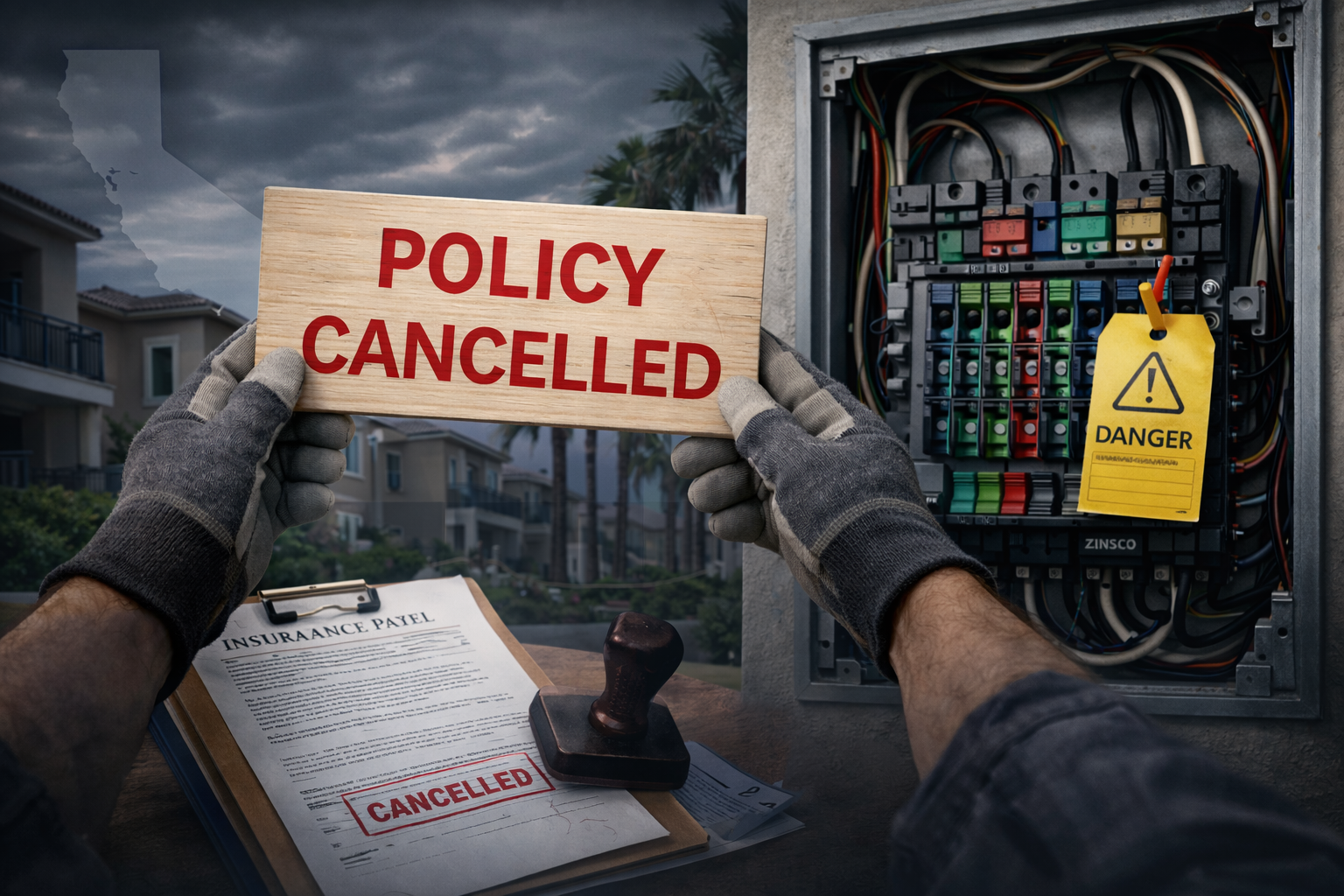
First, the insurance industry has fundamentally changed its approach to electrical risk. Major insurance companies are withdrawing from the market, and those that remain have implemented strict underwriting requirements that flag older electrical panels as unacceptable hazards. HOA communities are receiving non-renewal notices, policy cancellations, and denials tied directly to their electrical systems. Carriers are focused on risk mitigation to prevent catastrophic losses—major fires or system failures caused by aging or outdated equipment.
Second, Senate Bill 382 has put electrical safety squarely in the spotlight. While SB 382 is a seller-disclosure law—not an HOA compliance mandate—its January 1, 2026, effective date has significantly raised awareness of electrical panel concerns among property owners and buyers alike. Communities with known hazardous electrical panels will face increasing scrutiny in every property transaction.
Third, a supply chain crisis is building. As thousands of HOA communities respond to carrier pressure and growing safety awareness, the demand for replacement equipment, breakers, and qualified contractors is outpacing supply. Communities that wait will face longer lead times, higher material premiums, and fewer options.
This guide explains what is driving each of these forces, what your board’s legal obligations are under state law, and the specific steps you need to take to keep your property safe and insurable. We have written this article to be the most accurate and comprehensive resource available on this topic—because HOA boards deserve honest information, not misinformation disguised as urgency.
At Tradesman Electric, we have helped dozens of HOA communities navigate exactly this situation. What follows is everything we have learned.
The Insurance Crisis and What It Means for HOA Communities
The most immediate threat facing HOA communities with older electrical panels is not a law or regulation. It is the insurance industry itself.
Why Major Carriers Are Reducing Exposure
The home insurance market has undergone a dramatic contraction in recent years. State Farm stopped accepting new homeowner policy applications in 2023. Allstate and other carriers have significantly reduced their exposure. Farmers and others have pulled back from new business in the state.
These decisions are driven by a combination of factors:
- Catastrophic wildfire losses: The state has experienced some of the most destructive wildfire seasons in American history, with insured losses reaching billions of dollars. The frequency and severity of wildfire claims have made this a challenging market for property insurers.
- Regulatory constraints on premium pricing: The state’s regulatory framework has historically limited carriers’ ability to raise insurance premiums to reflect actual risk levels. This has made it difficult for underwriters to price policies at actuarially sustainable levels.
- Aging infrastructure across the state: The building stock includes a large share of older construction, and deferred maintenance—including outdated electrical systems—poses increasing exposure.
For HOA communities, the practical impact is severe. Fewer carriers writing policies means less negotiating power and dramatically increased costs for property owners. Communities that once had multiple home insurance options now struggle to secure a single policy. When they do find an existing policy willing to renew, premiums have often doubled or tripled.
Why Panels Have Become the Top Underwriting Red Flag
In this tightening market, panels have become a top underwriting concern for HOA communities. Carriers have access to extensive claims data, and the data clearly shows that older electrical panels—particularly certain brands—are significantly overrepresented in residential fire claims. Older electrical panels, particularly those manufactured before the 1970s, are frequently flagged by insurers as a fire hazard. A panel’s age is a critical factor in every assessment, because an outdated panel increases the risk of failure and non-compliance with modern safety standards, leading to insurance issues such as denial or non-renewal.
From the underwriter’s perspective, the calculation is straightforward:
- FPE units have documented breaker failure rates of 60-70% under overcurrent conditions, based on independent testing by electrical engineer Dr. Jesse Aronstein. Covering a property with an electrical panel that fails to protect against faults the majority of the time is unacceptable.
- Zinsco models exhibit documented patterns of aluminum bus-bar corrosion that cause invisible arcing behind the equipment face. They can appear fully operational while developing an undetectable fire hazard inside the unit.
- The legal liability chain creates additional exposure. If a fire occurs at a property with a documented electrical panel safety concern, and the insurer knew the panel was present, the carrier may face bad-faith claims for covering a known safety hazard.
The result is an industry-wide shift: many insurance companies decline to write or renew policies for properties with these panel types. Switching carriers does not solve the problem, because new applications typically face even stricter scrutiny than renewals. Property owners who shop around quickly discover this is a systemic change, not an individual carrier’s decision.
How Carriers Are Responding
We see several patterns in how insurance companies are handling panel concerns in HOA communities:
Non-renewal notices: The most common scenario. The carrier informs the HOA that its home insurance policy will not be renewed unless the specified equipment is replaced, typically with a 30-, 60-, or 90-day compliance window.
Mandatory pre-renewal inspections: Some carriers now require professional inspections before issuing or renewing HOA policies. Inspectors look specifically for Federal Pacific, Zinsco, Pushmatic, Bulldog, and Challenger brands.
Higher premiums: Communities with older equipment that have not yet triggered non-renewal may see premium increases of 40-100% or more. Some are forced to secondary or surplus market carriers at three to five times the cost, dramatically increasing what communities pay.
Outright denial: New policy applications are denied if hazardous equipment is present. HOAs shopping after a non-renewal find that no standard-market carrier will issue a home insurance policy until the work is done. In practice, insurance companies require HOA communities to replace outdated electrical panels as a condition of maintaining coverage—there is no alternative path to reinstatement.
Insurance premium volatility in the state market has made budgeting extremely difficult for HOA boards. Premiums can swing dramatically from one renewal cycle to the next, and communities with flagged equipment face the most unpredictable pricing. If an HOA’s master policy is canceled due to outdated equipment, the consequences cascade quickly: individual units become difficult to insure independently, and mortgage lenders may enforce force-placed insurance at rates 300% to 500% or more above standard premiums. The cost of securing new coverage often increases and may result in special assessments for homeowners—an expense that could have been avoided with proactive panel replacement. Residents could also be personally liable for damages caused by fires spreading from faulty equipment in their units, creating individual exposure beyond the community’s collective liability.
Under California law, carriers must provide at least 75 days’ notice before non-renewing a homeowner’s policy. However, this notice period is not as generous as it sounds—75 days is barely enough time to select a contractor, procure materials, and complete a community-wide replacement project, especially if supply chain delays are a factor. Boards that wait until they receive a non-renewal notice are already behind.
When no standard carrier will write a policy: If your community has exhausted standard-market options and cannot secure home insurance from any admitted carrier, the California FAIR Plan exists as an insurer of last resort. The FAIR Plan provides basic fire coverage, but it is limited in scope, is more expensive, and does not provide the comprehensive coverage most CC&Rs require. It should be considered a temporary bridge while the replacement project is completed—not a long-term solution.
If you believe a cancellation is unjustified, HOA boards and individual homeowners have the right to file a complaint with the California Department of Insurance (CDI). The CDI reviews complaints about policy cancellations and non-renewals and can intervene if a carrier has violated state regulations. While filing a complaint does not guarantee reinstatement, it creates a documented record and ensures regulatory oversight. However, in most cases involving documented hazardous equipment, the most effective path forward is replacement rather than dispute.
This is the reality we hear about from board members and property managers every day. The industry is not waiting for any law to force its hand—insurance companies are making independent decisions based on risk data, and those decisions impact thousands of communities right now.
The Panel Brands That Trigger Action
Not all older equipment raises the same level of concern. Insurance companies have identified specific panel brands that represent elevated concern based on documented failure patterns, independent testing, and claims data. Several of these brands are now considered effectively uninsurable—meaning no standard-market carrier will write or renew a home insurance policy for a property where this equipment is present. Homeowners should proactively replace or certify the condition of their equipment to avoid insurance issues, and HOA boards are obligated to address these conditions in common areas.
A note on “recalled panels”: Many sources—including other contractor websites, industry publications, and even some insurance documents—describe Federal Pacific Electric and Zinsco panels as “recalled panels.” This is inaccurate. No formal CPSC recall was ever issued for FPE or Zinsco brands. However, the documented concerns are severe enough that carriers deny coverage for homes with this equipment, regardless of recall status, effectively treating them as uninsurable. Only certain Challenger breakers and models have been the subject of actual CPSC recalls. Getting this distinction right matters—especially when your board is making decisions that may be scrutinized by attorneys, insurance adjusters, or regulators.
Here is what you need to know about each panel brand.
Federal Pacific Electric (FPE) and Stab-Lok Panels
Installed: Primarily 1950s through 1980s, with peak installation in the 1960s and 1970s
Why they are dangerous: FPE equipment is widely regarded as the most dangerous residential electrical equipment ever manufactured. Independent testing by Dr. Jesse Aronstein documented that FPE Stab-Lok breakers fail to trip approximately 60-70% of the time under overcurrent conditions. When an electrical fault occurs—exactly the moment when the breaker should protect your property by cutting power—FPE Stab-Lok breakers remain energized the majority of the time.
The Consumer Product Safety Commission investigated FPE Stab-Lok breakers from 1980 to 1983. The CPSC closed the investigation without reaching a definitive safety determination, partly due to budget constraints, but the investigation itself—combined with independent testing, court findings, and class-action litigation—contributed to widespread recognition of the hazard. FPE’s UL listing was challenged after court findings and corporate disclosures revealed that the company obtained its certifications through deceptive and improper practices, including falsified test data. The 2002 New Jersey Superior Court found that FPE violated the Consumer Fraud Act. Multiple class-action lawsuits have documented thousands of fire incidents, including house fires, involving FPE equipment.
How to identify: Look for “Federal Pacific Electric” or “FPE” on the panel door. The distinctive Stab-Lok breakers are thinner than modern breakers and often have red or orange toggle switches. Any home inspector or licensed electrician who opens this breaker box will immediately recognize the hazard.
Insurance impact: FPE equipment is considered uninsurable by virtually every standard-market carrier due to documented inability to trip under overload conditions, creating hazards that no underwriter will accept. Most carriers will not write new homeowner policies on properties with this equipment.
Zinsco (Sylvania-Zinsco) Panels
Installed: Primarily 1950s through 1970s. Especially common in the Southwest
Why they are dangerous: Zinsco units use aluminum bus bars that corrode and oxidize over time. This corrosion degrades the connection between breakers and bus bars, increasing resistance, causing heat buildup, and leading to arcing. The critical concern is that this arcing occurs behind the unit face, making it invisible during normal inspection. Zinsco equipment can appear fully operational while developing a fire hazard that only becomes apparent during catastrophic failure—potentially causing significant damage, house fires, or worse.
Additional failure modes include breakers melting to the bus bar, breakers losing contact and falling out of position, and breakers failing to trip during overcurrent conditions. Fire investigations have repeatedly identified Zinsco equipment as the origin point of residential fires.
Why especially common here: Zinsco was manufactured locally and was widely installed during the post-World War II housing boom. Many tract developments and planned communities in Orange County, Los Angeles, and San Diego used Zinsco equipment exclusively. Many HOA communities built during this era have this equipment throughout—and residents may not realize the risk until a carrier flags the problem.
How to identify: Look for “Zinsco,” “Sylvania,” or “GTE-Sylvania” on the panel cover. Zinsco breakers are distinctive for their colorful toggle handles—often blue, red, yellow, or green. The interior has a noticeably aluminum appearance. A professional can verify identification and assess condition.
Insurance impact: Zinsco equipment is flagged by insurers due to documented failures, including arcing and overheating. Carriers often deny coverage for homes with Zinsco equipment, making them effectively uninsurable on the standard market.
Pushmatic and Bulldog Panels (ITE)
Installed: 1950s through 1980s. Same manufacturer (ITE) under different branding
Why they are problematic: Pushmatic units use a push-button mechanism rather than the toggle switches found in modern breakers. Over decades of service, the push-button design wears out, causing buttons to stick, fail to trip, or fail to reset. After 40 to 70 years, these mechanisms are well beyond their design life.
Beyond the mechanical issues, these units present several additional concerns. Many Pushmatic and Bulldog models lack a main shutoff breaker. They are typically rated for only 60 to 100 amps—well below the 200-amp service required by modern standards. Replacement breakers are no longer manufactured, making repairs impossible and proper permits for upgrades unattainable without full panel replacement. These outdated units cannot accommodate modern AFCI and GFCI breakers, now required by code.
How to identify: The push-button breakers are unmistakable—no other panel type uses them. Look for “Pushmatic,” “ITE,” or “Bulldog” on the panel.
Challenger Panels (Certain Models)
Installed :Primarily 1980s through 1990s
Why certain models are problematic: Unlike FPE and Zinsco, not all Challenger models are considered unsafe. The concern is limited to specific models with documented issues in bus bar connections, which can result in loose or degraded wiring, breaker retention problems, and quality control issues. Affected models may fail to trip under overload conditions, posing serious risks. Some carriers flag all Challenger equipment as potentially uninsurable, while others require model-specific inspection to determine whether the unit is affected.
Importantly, some Challenger models have been the subject of actual CPSC recalls—making them the only brand on this list where a recalled panel designation genuinely applies. In 1988, the CPSC recalled about 9,000 GFCI breakers (Type HAGF-15 and HAGF-20) for failing to provide ground-fault protection. In 2014, Eaton—which acquired the Challenger brand—recalled approximately 1,000 Challenger-branded pieces of equipment whose electrical components were too easily accessible, posing a shock hazard. These were real CPSC recalls with documented recall numbers—unlike FPE and Zinsco, which were investigated but never formally recalled.
How to identify: Look for “Challenger” on the panel. The model number, typically found on a label inside the panel door, determines whether the specific unit is affected.
Wadsworth Panels
Installed: Primarily 1950s through 1960s
Why they are problematic: Wadsworth equipment is flagged primarily due to its extreme age and complete obsolescence. This equipment is now 60 to 70 years old—well beyond any reasonable service life. The manufacturer no longer exists, there are no replacement components, and the design does not meet current standards. Its age alone is a concern, and any Wadsworth equipment still in service should be replaced to ensure the property’s safety.
Panel Comparison Summary
Panel Brand | Era | Primary Concern | Key Evidence | Status |
|---|---|---|---|---|
Federal Pacific (FPE) | 1950s-1980s | Breakers fail to trip 60-70% of the time | Aronstein testing, CPSC investigation, fraudulent UL listing | Automatic non-renewal |
Zinsco | 1950s-1970s | Aluminum bus bar corrosion, invisible arcing | Fire investigations, documented failure patterns | Automatic non-renewal |
Pushmatic / Bulldog | 1950s-1980s | Mechanical failure, no parts, undersized | Age, obsolescence, code non-compliance | Increasingly flagged |
Challenger | 1980s-1990s | Model-specific defects | 1988 and 2014 CPSC recalled panel actions | Model-dependent |
Wadsworth | 1950s-1960s | Extreme age, complete obsolescence | Age-based deterioration | Flagged due to age |
What SB 382 Actually Requires (And What It Does Not)
There is significant misinformation circulating about Senate Bill 382. Some of this misinformation has appeared in industry publications, contractor marketing materials, and even articles written for HOA boards. It is important to set the record straight so that boards can make decisions based on facts.
What SB 382 Is
Senate Bill 382 (authored by Senator Josh Becker, Chapter 443, Statutes of 2024) was signed by Governor Newsom on September 22, 2024. It adds Sections 1102.6i and 1102.6j to the Civil Code. It is a seller disclosure law.
Effective January 1, 2026, SB 382 requires sellers of single-family residential property (or their agents) to deliver a disclosure statement to prospective buyers advising the following:
- It may be advisable to obtain an inspection by a qualified professional of the electrical systems, including the main service panel, subpanels, and wiring
- Substandard, recalled, or faulty wiring may cause a hazard and may make it difficult to obtain property insurance
- Limited electrical capacity may make it difficult to support future additions such as solar generation, electric space heating, or electric vehicle charging equipment
What SB 382 Does Not Do
This is critical for boards to understand. SB 382 does not:
- Impose any requirements on HOA boards or associations
- Mandate electrical panel inspections by any entity
- Create documentation or disclosure obligations for associations
- Establish compliance deadlines for HOAs or common interest developments
- Create civil liability for board members
- Require electrical panel upgrades or replacements
The January 1, 2026, date is when the seller disclosure requirement takes effect. It is not a compliance deadline by which communities must complete any specific actions.
Why SB 382 Still Matters for HOA Communities
Although SB 382 does not directly regulate HOA boards, it has important practical implications throughout your community:
Increased buyer scrutiny. When homeowners sell units after January 1, 2026, buyers will receive disclosure statements advising them to inspect electrical systems. In communities with known hazardous equipment, this will affect sale prices and transaction timelines. Home inspectors will flag these same issues.
Property value impact. Communities that have not addressed these concerns will see this reflected in property values. Conversely, communities with an upgraded panel throughout the development will have a competitive advantage. Maintaining home insurance eligibility also protects property values for every owner.
Signal of regulatory direction. SB 382 reflects growing legislative attention to residential electrical safety. While the current law only addresses sellers, it signals that policymakers view aging infrastructure as a serious concern.
Your Board’s Actual Legal Obligations
While SB 382 does not impose obligations on HOA boards, boards have significant legal duties regarding electrical safety under existing law. These obligations come from the Davis-Stirling Common Interest Development Act.
The Davis-Stirling Act: Maintenance Duties
The Davis-Stirling Act (Civil Code Sections 4000 through 6150) governs HOA operations. Section 4775 establishes that the association is responsible for maintaining, repairing, and replacing common area components. For most HOA communities, electrical infrastructure serving common areas is the board’s maintenance responsibility.
This means that if common-area electrical equipment is in an unsafe condition, the board has a legal obligation to address the issue to keep the property safe—regardless of SB 382 or carrier requirements.
Fiduciary Duties
HOA board members have fiduciary duties under Civil Code Sections 5500 through 5510. These include duties of care and loyalty requiring members to act in the association’s best interests. HOA boards have a fiduciary duty to maintain proper insurance and must prioritize necessary electrical upgrades once flagged by insurance carriers. When a board becomes aware of a known safety hazard—such as equipment with documented failure rates—the duty to act is triggered.
The “known hazard” concept is critical. Once a board is informed that the community has FPE, Zinsco, or other equipment with documented fire hazards and known deficiencies, failure to take reasonable steps to address them creates liability exposure. This is true whether the information comes from a carrier, a contractor, a resident, or this article. Property owners can and do hold boards accountable for inaction on known hazards.
The Home Insurance Obligation
Most CC&Rs require HOA boards to maintain adequate insurance coverage. Mortgage lenders also require master policies, and under Fannie Mae and Freddie Mac guidelines, inadequate coverage affects every property owner with a mortgage.
When carriers require the replacement of outdated equipment as a condition of the home insurance policy, boards face a dual obligation: maintaining safe common areas and maintaining coverage. Failing to address the issue jeopardizes both safety and insurance coverage, and meeting carrier requirements is essential to maintain coverage.
What Documentation Protects the Board
Board members can protect themselves by documenting diligent action. The standard is not perfection—it is good faith effort. Critical documentation includes:
- Board meeting minutes showing when the issue was identified
- Professional inspection reports documenting equipment conditions
- Records of contractor bids and selection
- Correspondence with carriers
- Homeowner notifications
- Timeline of all actions taken
Boards that document their decision-making are well-positioned to defend against negligence claims and ensure compliance with their fiduciary obligations.
The Coming Supply Chain Challenge
Beyond carrier pressure and legal obligations, boards face a practical challenge: the supply of equipment, breakers, and qualified contractors is finite, and demand is increasing rapidly.
Current Conditions
As of early 2025, lead times are manageable—typically four to six weeks for standard residential equipment from major manufacturers. Breakers are generally available with one- to two-week lead times. Qualified contractors can typically be booked within two to four weeks.
These conditions represent a window of opportunity that will not remain open indefinitely.
Why Conditions Will Tighten
The fundamental math is concerning. Industry estimates suggest there are 50,000 or more HOA communities in the state. Even a conservative scenario illustrates the scale of the challenge: if 20 percent need replacements, that represents roughly 10,000 communities. At an average of 100 units per community, the total demand approaches one million units—well beyond what domestic manufacturing can absorb in a single year.
This imbalance will become more pronounced as awareness grows. The pattern is predictable: lead times will extend, costs will rise, and contractor availability will shrink. Communities that act early lock in current pricing and secure materials before shortages develop. Communities that wait will face emergency pricing at significant premiums.
Lessons from Recent Supply Crises
This pattern has played out repeatedly. During the COVID-19 pandemic, lead times stretched to six to twelve months, and prices doubled. Following the 2021 Texas freeze, availability evaporated within weeks. Wildfire rebuilds created material shortages that took three or more years to normalize. In every case, communities that acted early fared dramatically better, avoiding both catastrophic schedule losses and the premium pricing that comes with emergency procurement.
What Your Board Should Do Now
Based on our experience helping dozens of HOA communities, here is the action plan we recommend. Property owners and boards should follow these steps as a risk-mitigation measure to protect the community and maintain coverage.
Month 1: Assessment and Investigation
- Schedule a professional panel inspection across all units. A visual check by a board member is not sufficient—you need a licensed electrician to inspect, photograph, and document every unit. While home inspectors can identify some panel brands, a licensed electrician provides the thorough assessment carriers require. Homeowners should not attempt to evaluate panels themselves. Internal conditions like bus bar corrosion and breaker contact integrity require professional evaluation.
- Identify which units are common area (HOA responsibility) versus individual units (homeowner responsibility per your CC&Rs).
- Receive a written report with equipment brands, ages, conditions, and risk assessment.
- Present findings at the next board meeting.
Cost: Tradesman Electric provides free community-wide assessments with written reports and photo documentation. No obligation.
Month 2: Board Education and Planning
- Review your policy terms, renewal date, and any existing warnings from your carrier.
- Contact your broker to discuss findings and renewal requirements.
- Consult with your HOA attorney on fiduciary duties (recommended).
- Begin discussing funding options: reserve funds, special assessment, HOA loan, or a phased approach.
Month 3: Contractor Selection
- Request detailed proposals from two to three qualified contractors with HOA experience.
- Evaluate proposals on project management capability, material procurement approach, and warranty terms.
- Check contractor licenses and references from comparable HOA projects.
- Select a contractor by board vote and obtain proper permits.
Critical qualifications: 100-plus replacement projects completed, dedicated project coordinator, project management software, warehouse capability for material procurement, and a strong warranty. A general electrician cannot manage a 100-unit community-wide upgrade project.
Month 4: Financing and Communication
- Finalize funding and obtain board or homeowner approval as required.
- Prepare homeowner communication explaining why the work is necessary, the timeline, and any costs involved.
- Schedule a town hall for residents.
Month 5: Procurement and Scheduling
- Contractor orders all replacement equipment and materials. Pre-procurement avoids supply chain delays.
- Create a unit-by-unit installation schedule.
- Coordinate with SCE for meter spot requests (four to eight weeks’ lead time).
- Begin the permitting process. When planning an electrical panel upgrade or replacement, obtaining proper permits is a critical step for both code compliance and insurance coverage. Failing to obtain necessary permits can have serious consequences, including carriers denying coverage or rejecting claims related to electrical fires. Carriers require that all electrical work, especially panel upgrades, be performed in accordance with current electrical codes and local regulations—unpermitted work can void your policy. Carriers require compliance with current electrical codes, which often necessitates replacing outdated or uninsurable equipment to maintain coverage.
Month 6: Project Kickoff
- Begin replacements according to the schedule.
- Track progress through the contractor’s reporting system.
- Receive regular board updates.
What happens on installation day: A licensed electrician arrives at the unit in the morning. Power is shut off, typically by 8:00 AM. The old unit is carefully removed, and the new one is mounted in the same location. The electrician connects all existing circuits to the new equipment, traces and labels every circuit for accuracy, and installs modern safety devices, including AFCI (arc-fault) and GFCI (ground-fault) breakers, where required by current code. New grounding and bonding connections are installed to meet NEC requirements, including UFER grounding where applicable. Surge protection is installed to protect sensitive electronics. Carriers typically require a minimum 100-amp service for residential properties, though most modern installations use 200-amp panels to safely handle today’s electrical loads—including EV chargers, solar installations, and high-draw appliances. The new unit is rated for 200-amp service, providing the capacity your community needs. A city inspector verifies the work before power is restored, typically by 5:00 PM the same day. Each unit requires one day of work. No overnight outage, no displacement required. If stucco or siding was disturbed during the work, repair and paint matching are completed as part of the service.
Why timing matters: Replacements for outdated electrical panels must typically be completed within the compliance window specified in your non-renewal notice—often 30, 60, or 90 days—to avoid total loss of coverage. Missing this deadline can leave the community entirely uninsured, triggering mortgage lenders to act and potentially force-placing insurance at extreme cost. Homeowners should consider a proactive approach in replacing their equipment rather than waiting for a compliance deadline.
Post-Project: Documentation
- Collect all permits, inspection sign-offs, and completion documentation.
- Provide the carrier with a complete documentation package to ensure compliance and maintain coverage.
- Archive records for future reference, including resale disclosures and audits.
- Receive warranty documentation.
Five Misconceptions That Put Communities at Risk
Misconception 1: Our panels have worked fine for 40 years. If they were a safety hazard, something would have happened by now.
Panel failure is sudden, not gradual. A panel can appear operational for decades and fail catastrophically during its first serious fault. The panel’s age does not prove reliability—it proves the panel has never been seriously tested. The 60-70% failure rate documented for FPE breakers indicates that most have never encountered a real overcurrent event. The question is whether you want your community to learn, through an electrical fire, that panel failure is instantaneous and catastrophic.
Misconception 2: Carriers are overreacting. We can negotiate or switch.
This is an industry-wide shift driven by actuarial data. Switching carriers does not help—new applications face stricter scrutiny than renewals. Surplus market carriers may offer temporary home insurance, but at three to five times standard premiums, resulting in dramatically increased costs for property owners. There is no escape hatch.
Misconception 3: We can wait and do this with everyone else.
Waiting means competing with tens of thousands of other communities for a limited supply. Lead times will extend. Pricing will increase. Scheduling an electrical panel upgrade now lets your community save money by locking in current pricing and completing the project on your own timeline.
Misconception 4: We cannot afford this at this time.
The cost of panel replacement is high. But the cost of inaction is far greater. Without home insurance, the HOA cannot legally operate. Fire liability from known hazardous equipment exposes the board to millions in potential damages and significant damage claims. Property sales halt when buyers cannot obtain coverage. An emergency replacement later costs far more than a proactive one now. Financing options include reserve funds, special assessments, HOA loans, and phased approaches—all of which help property owners manage costs.
Misconception 5: Our property manager will handle this.
Property managers advise boards—they do not make decisions. Board members have a fiduciary duty to act. The board must own this decision and drive the timeline. The property manager can facilitate, but the board is responsible for meeting its obligations to property owners.
What Your Community Gains from Electrical Panel Replacement
Replacing outdated equipment is not just about satisfying carrier requirements—it delivers tangible benefits that improve safety, property values, and quality of life for everyone in the community.
Reduced fire risk. Modern electrical panels significantly reduce the risk of electrical fires. For communities with FPE or Zinsco equipment—where breaker failure rates of 60-70% have been documented—the improvement is substantial. Electrical panels play a crucial role in protecting a property by containing breakers that automatically trip in the event of a power surge, short circuit, or overload—protection that outdated equipment cannot reliably provide.
Insurance stability. Communities with upgraded equipment eliminate the primary trigger for non-renewal and can return to the standard insurance market with competitive pricing. Replacing outdated equipment increases the chances of home insurance claims being approved and policies being renewed. Replacing outdated equipment can also lead to lower homeowners insurance premiums, as carriers reward communities that eliminate known hazards. This protects every homeowner from the financial burden of surplus-market premiums or coverage gaps.
Increased property values. Upgrading to a modern electrical panel increases the resale value of homes in the community. Buyers are more confident when purchasing in communities with modern electrical infrastructure, especially after SB 382 raises buyer awareness of panel conditions. An upgraded panel is a selling point that supports faster transactions and stronger sale prices.
Modern capacity and performance. Upgrading electrical panels improves overall electrical performance and accommodates future upgrades for modern appliances. New 200-amp service supports today’s demands—EV chargers, solar generation systems, home offices, modern HVAC, and high-draw kitchen appliances—without overloading circuits or requiring additional subpanels.
Code compliance. New installations meet current NEC standards, including AFCI and GFCI protection in required locations, proper grounding and bonding, and labeled circuits. This satisfies both local building codes and carrier requirements.
Reduced long-term maintenance costs. Modern equipment from manufacturers such as Square D, Eaton, and Siemens includes manufacturer warranties and is compatible with readily available replacement breakers. Boards no longer face the impossible task of sourcing obsolete parts for discontinued equipment.
How Tradesman Electric Makes This Process Manageable
We understand that the combination of carrier pressure, legal obligations, supply chain challenges, and project complexity is daunting. That is exactly why we built our entire business around solving this specific problem for HOA communities and property owners.
What Sets Us Apart
- Since 1991. C-10 License #1049948. We are not a general contractor that occasionally does panels. HOA panel replacement and electrical panel upgrades are our core business.
- 400-plus panels replaced annually with a 16-person dedicated crew. We have the capacity to handle large community projects without subcontracting critical work.
- 16,000 square foot warehouse facility. We pre-procure and store all replacement equipment and materials, eliminating supply chain delays.
- Monday.com project tracking. Boards get real-time visibility into progress with weekly status reports.
- Full-time project coordinators. Dedicated team handles scheduling, homeowner communication, permit coordination, and utility liaison—maintaining standards at every step.
- Code-compliant installation to modern safety standards. All installations meet current NEC requirements, so every property receives an upgraded panel built to today’s standards.
- Lifetime workmanship guarantee. Twenty-year warranty on all work.
Our Complete Service
Pre-project: Free community-wide inspection, photo documentation of every installation, written assessment, and competitive volume pricing.
Project management: Permit applications, utility coordination, homeowner communication, circuit tracing, and inspector coordination—all coordinated to meet codes and carrier requirements.
Execution :Code-compliant installation, UFER grounding and bonding, surge protection, same-day power restoration, and stucco repair with paint matching.
Post-project: Final inspection sign-offs, complete documentation package for your carrier, permit copies for each address, compliance certification, and lifetime warranty activation—everything you need to keep coverage intact.
Carrier Deadline Response
If your community has already received a non-renewal notice, we offer an expedited response. We can typically complete an emergency assessment within 48 to 72 hours, provide a letter to your carrier documenting the action plan, and prioritize scheduling to meet your deadline. We have successfully completed projects by deadlines in as few as 45 days when materials are available.
The Choice Before Your Board
The forces converging on HOA communities—carrier tightening, growing awareness of panel hazards, legislative attention through SB 382, and building supply chain pressure—are not going to reverse. They are going to intensify.
Boards that act proactively will secure current pricing and save money before demand-driven increases, guarantee material availability, complete projects without deadline pressure, maintain insurance coverage without interruption, protect board members through documented due diligence, and keep property safe throughout the community.
Boards that wait will face emergency pricing, material delays of six months or longer, potential lapses in their home insurance policy, liability exposure from documented inaction, and property value impacts that affect every property owner.
The information in this article is not intended to create panic. It is intended to give your board the factual foundation to make an informed decision. The situation is serious, but it is entirely manageable for boards that act promptly.
Your next step: Schedule a free community-wide assessment. Within 48 hours, you will receive a complete assessment, photo documentation, and a clear understanding of the required action. There is no obligation and no cost.
Schedule your free inspection today.
Tradesman Electric: (949) 978-0535
https://tradesmanelectric.com/
Sources and References
California Legislative Information: SB 382 (Becker, Chapter 443, Statutes of 2024), adding Civil Code Sections 1102.6i and 1102.6j
Davis-Stirling Common Interest Development Act: Civil Code Sections 4000-6150, including Section 4775 (maintenance duties) and Sections 5500-5510 (fiduciary duties)
Consumer Product Safety Commission: Investigation of Federal Pacific Electric equipment (1980-1983), closed without reaching a definitive safety determination
Dr. Jesse Aronstein: Independent testing of FPE Stab-Lok breakers documenting 60-70% failure rates during overcurrent conditions
Eaton/CPSC: 1988 recall of Challenger GFCI breakers (Type HAGF-15 and HAGF-20); 2014 recall of certain Challenger-branded models for shock hazard
NFPA: Electrical distribution equipment—the category that includes electrical panel failures and electrical fires—is the third leading cause of home fires overall, and the second leading cause of nonconfined (more serious) residential fires