
This article has been independently fact-checked against primary sources, including the Davis-Stirling Common Interest Development Act, California Civil Code, CPSC investigation findings, and California insurance market data. All claims are sourced and verified as of February 2026.
Managing a community-wide HOA electrical panel replacement is the most complex infrastructure undertaking most boards will ever oversee. It involves insurance carriers, city permit offices, utility companies, dozens or hundreds of individual homeowners, licensed electricians, and a supply chain that can shift quickly. The stakes are high: insurance coverage, board liability, property values, and the physical safety of every resident depend on how well the work is planned and executed.
Most of the information available to boards is incomplete. It focuses on urgency — and the urgency is real — without giving boards a practical roadmap for what upgrading electrical systems in a community-wide engagement actually looks like from start to finish.
This playbook covers the full 20-step process Tradesman Electric uses to take HOA communities from initial inquiry to completed work with carrier documentation in hand. It draws on real experience, including two Orange County communities — Dana Bluffs HOA and Lakeglen HOA — that took different paths to the same outcome. And it addresses the questions boards ask most often: What does this look like unit by unit? Who is responsible for what? How do we communicate with homeowners? What separates a firm that can handle this from one that cannot?
If your community has Federal Pacific Electric, Zinsco, Pushmatic, Bulldog, Challenger, or Wadsworth panels, this is the guide your board needs before the first contractor conversation.
Your Board’s Legal Foundation Before the Work Begins
Before getting into process, every board member needs to understand the legal context that makes this work not just advisable but obligatory.
The Davis-Stirling Maintenance Duty
The Davis-Stirling Common Interest Development Act (California Civil Code Sections 4000 through 6150) governs HOA operations in California. Section 4775 establishes that the association is responsible for maintaining, repairing, and replacing common area components. For most HOA communities, electrical systems serving common areas — meter panels, main service equipment, distribution panels — are the board’s maintenance responsibility under California law.
This is not discretionary. If common area electrical systems are in unsafe condition, the board has an existing legal obligation to address it regardless of what insurers require or what any new legislation says. HOAs are responsible for maintaining and repairing shared electrical infrastructure, including street lighting, common building wiring, and other shared infrastructure.
The Fiduciary Duty That Activates on Knowledge
HOA board members have fiduciary duties under Civil Code Sections 5500 through 5510, including duties of care and loyalty. The critical concept in California law is the known hazard principle: once a board is informed that the community has panels with documented safety concerns — through a carrier notice, an inspection report, a homeowner complaint, or this article — the duty to take reasonable steps is triggered. Ignoring that obligation can expose the board to legal action and individual liability.
Boards that document their response to a known hazard are in a defensible position. Boards that receive the information and take no action are exposed to personal liability. Clear documentation and timely communication are essential — not just good practice. They are the primary legal protection available to individual board members.
The Insurance Obligation
Most CC&Rs require boards to maintain adequate insurance coverage. Mortgage lenders require HOA communities to carry master policies, and under Fannie Mae and Freddie Mac guidelines, inadequate coverage creates problems for every homeowner with a mortgage. HOAs may mandate the replacement of outdated, dangerous panels like Zinsco or Federal Pacific within a specific timeframe to prevent fire hazards and protect insurability. When insurers require panel work as a condition of coverage, boards face simultaneous obligations: maintain safe common areas and maintain insurance. Failing to address the panel issue jeopardizes both.
Homeowners should review their insurance policies to confirm the scope of coverage related to electrical systems in their units. Homeowners may be required to replace outdated panels if their HOA mandates it due to insurance coverage problems. HOAs generally cannot deny a necessary panel upgrade — but they do impose regulations on aesthetics, contractor licensing, and work hours that must be followed. Changes to panels must comply with community appearance standards, including specifications for conduit colors and enclosure finishes where applicable.
Why Upgrading Electrical Panels Is Different from Everything Else on Your Maintenance Schedule
A roof repair affects the building envelope. A pool resurfacing disrupts amenity access. Upgrading electrical panels in a community-wide engagement affects every home, requires coordination with a utility company and city inspectors, involves safety work inside individual homes, and directly determines whether the community can maintain insurance coverage.
The complexity is real, but it is entirely manageable — with the right process and the right firm. The communities that struggle are those that treat this like a standard maintenance task and hand it off to a general electrician with a truck and a toolbox. This is not a DIY project. California law requires licensed professional installation for panel work, and beyond the legal requirement, the project management demands of a community of this scale make professional installation by an HOA-experienced firm essential. A general electrician handling individual service calls has no infrastructure for upgrading electrical systems across 50 to 500 homes simultaneously.
The communities that succeed treat this like what it actually is: a coordinated infrastructure program that requires discipline, deep HOA experience, and proactive communication at every stage. Improper installations can create safety hazards, reduce property value across the community, and lead to fines or correction orders from the city.
The 20-Step Community-Wide Replacement Process
Phase 1: Assessment and Discovery (Steps 1–5)
Step 1: Initial Inquiry and Needs Assessment
The process begins with a conversation. The board or property manager contacts Tradesman Electric to discuss the community’s situation — what panels are present, what the carrier has said, and what timeline pressure exists. A community with a 90-day carrier deadline needs a different response than one acting proactively. Understanding the starting point determines the pace of every subsequent step.
Step 2: Free Community-Wide Assessment Scheduling
Within 48 hours of the initial contact, a licensed electrician is scheduled to conduct a comprehensive on-site evaluation of every home and common area. This is not a drive-by or a spot check of a few representative homes. Every electrical panel in the community is inspected. Tradesman Electric provides this evaluation at no charge and with no obligation — because boards cannot make sound decisions without accurate data, and accurate data requires a professional inspection of the entire property.
Step 3: On-Site Inspection of All Units and Common Areas
The team moves through every unit, opening each panel and evaluating brand, age, condition, and configuration. Inspectors identify whether panels are in common areas or individual residences, which determines responsibility under the CC&Rs. If a panel serves only one unit, it is generally the owner’s responsibility for cost and maintenance. If it serves multiple units, the HOA may be responsible. Inspectors also look for secondary concerns beyond panel brand — evidence of overheating, heat damage, discoloration around circuit breakers controlling lights and major appliances, amateur modifications, undersized electrical load capacity, and code compliance issues that will affect scope.
This is where hidden complexity surfaces. At Lakeglen HOA, a 129-unit condominium community in Orange County, the inspection revealed that more than 80 units required access box modifications in addition to panel work — a logistical challenge that could not have been anticipated without a thorough unit-by-unit walkthrough.
Step 4: Panel Photo Documentation and System Logging
Before any work begins at each unit, our team photographs every panel — capturing the panel face, interior bus bar condition, breaker configuration, manufacturer label, and any visible safety concerns. The unit address, panel brand and model, condition observations, and inspection date are recorded and entered directly into our Monday.com project management system, where they are tied to that address throughout the entire project. This photo and location record serves multiple purposes: it supports the written assessment report, satisfies insurance carrier requirements, creates a baseline record for future reference, and protects the board in the event of any dispute about pre-existing conditions. Every panel in your community is documented before a single replacement begins.
Step 5: Written Inspection Report with Risk Assessment
Within a defined timeframe after the inspection, the board receives a written report covering every panel in the community. The report identifies panel brands and ages, flags homes with the highest risk profiles, distinguishes between common area and homeowner-owned equipment, and provides a clear risk assessment the board can present to its insurer and legal counsel. This report is the foundation for every decision that follows.
Phase 2: Board Education and Planning (Steps 6–9)
Step 6: Board Presentation of Findings
The inspection findings are presented at a board meeting with enough detail for members to understand exactly what they are dealing with. The presentation covers the risk profile of the identified panels, the insurance implications, the legal responsibilities under the Davis-Stirling Act, the scope, and the timeline options available given current supply chain conditions. This is also the meeting where the issue gets formally entered into board minutes — an important step for the record trail that protects board members individually.
Step 7: Insurance Carrier and Broker Consultation
Armed with the inspection report, the board contacts its insurance broker to discuss findings and renewal requirements. The broker can confirm what the carrier will require, clarify any existing warnings or conditions on the current policy, and advise on the records the carrier will need to confirm compliance after the work is finished. Homeowners should request written communication from the HOA detailing the insurance issues and any replacement obligations that affect their homes. This conversation often reveals whether the community is already on a carrier watchlist.
Step 8: CC&R Review — Common Area vs. Homeowner Responsibilities
The CC&Rs determine which panels are the association’s maintenance responsibility and which belong to individual homeowners. This distinction matters for funding, legal liability, and how the work is structured. Homeowners should review the HOA’s CC&Rs and governing documents to confirm coverage rules for electrical repairs and understand responsibilities and dispute resolution procedures. If a problem is caused by HOA-owned equipment, the HOA typically pays for the repair. Homeowners may be liable for costs associated with electrical repairs if the issues arise from their personal modifications or installations.
Even when panels are technically homeowner responsibility, centralized management of the replacement work is almost always the correct approach. Individual homeowner delegation produces inconsistent quality, missing records, unpermitted work, and insurance compliance gaps. The HOA coordinating the work as a whole — even for homeowner-owned panels — ensures uniform standards, thorough documentation, and the volume pricing that benefits every homeowner.
Step 9: Legal Counsel Consultation on Fiduciary Duty
For work of this scope, consultation with the HOA’s legal counsel is strongly recommended before finalizing the structure. Counsel can advise on fiduciary duty requirements under California law, CC&R interpretation, funding authorization requirements, and what records are needed to protect board members individually. Homeowners can also consult governing documents to understand their own rights and dispute resolution procedures.
Phase 3: Contractor Selection (Steps 10–11)
Step 10: RFP Development and Outreach
The board develops a request for proposals and distributes it to qualified firms. The RFP should require detailed responses on management capability, crew size, warehouse capacity for material pre-procurement, communication systems, permit experience, utility coordination history, and warranty terms. The questions that matter most are not about price — they are about capability. Can this firm manage 100 or more units simultaneously without subcontracting key work? Do they have a dedicated coordinator, or will the board be managing communications themselves? Do they have warehouse space to pre-order and store materials? What tracking software do they use?
A general electrician who handles individual service calls cannot answer these questions satisfactorily. A firm that has completed hundreds of HOA electrical systems upgrades can. Violating electrical rules due to using an underqualified firm can lead to fines, correction orders, and removal of work — all of which fall on the board.
Step 11: Proposal Review and Board Vote
Proposals are reviewed against the RFP criteria and evaluated on the full scope of capability, not price alone. The board votes to approve a firm, and the decision is documented in meeting minutes. Critical qualifications to confirm before the vote: 100 or more HOA electrical systems upgrades completed, a dedicated full-time coordinator, tracking software with board-accessible visibility, warehouse capability to pre-procure and store materials, and a written workmanship warranty.
Tradesman Electric replaces more than 1,000 panels annually with a dedicated 12-person crew. Every engagement is managed through Monday.com with real-time progress tracking. Our 3,000 sq ft warehouse in Laguna Hills allows us to pre-procure and store all materials before a single installation begins — eliminating supply chain delays as a risk for your community. Our customers receive a dedicated coordinator from day one and weekly board reports throughout. Customer service is not a department — it is our entire company culture, and every customer we serve benefits from that standard from the first call to the final permit sign-off. When customers have urgent carrier deadlines, our pre-procured materials mean we can begin installing panels on schedule without waiting on supply chains. Learn more about our HOA panel replacement program.
Phase 4: Financing and Communication (Steps 12–13)
Step 12: Funding Determination and Approval
The work cannot proceed without a funded budget. Boards have several options: reserve funds, if the reserve study has allocated for infrastructure work; a special assessment, which requires proper notice and homeowner approval in accordance with the CC&Rs; an HOA loan, which spreads costs over time without a lump-sum assessment; or a phased approach that sequences work across multiple budget cycles. Each option has implications for homeowner approval requirements, timeline, and administrative complexity. The benefits of an HOA loan are worth understanding: it preserves reserve funds, avoids a large one-time assessment, and allows the board to complete all plans for the full scope of work without phasing compromises. Before signing any contract with a financing provider, boards should review the terms with legal counsel and confirm the plans align with reserve study projections.
Step 13: Homeowner Communication and Town Hall
Homeowner communication is not an afterthought — it is a management discipline. The first communication should go out before any work is scheduled, explaining why upgrading electrical systems is necessary, what the insurance stakes are, what homeowners should expect during installation, and what costs are involved. Homeowners must follow both HOA rules and state regulations when it comes to electrical work in their homes — and clear, early communication ensures they understand their responsibilities.
A town hall or informational meeting allows homeowners to ask questions in a structured setting before anxiety turns into disputes. The communities that experience the least friction during panel upgrading are those that over-communicate early and answer objections before they become complaints. Most HOAs require that homeowners receive notice 14 to 30 days before work begins, detailing the timeline and contractor information.
The communication strategy must account for absent owners. In communities with rental homes, the tenant and the owner may both need to be contacted separately. Tenant-installed electrical work must follow HOA rules and California codes — and tenants need to understand what access is required on installation day. At Lakeglen HOA, some homes were owned by off-site investors who were difficult to reach, which required the coordinator to maintain detailed contact logs for every address and pursue multiple outreach attempts through different channels.
Phase 5: Procurement and Permitting (Steps 14–16)
Step 14: Permit Applications Submitted
All electrical panel work must be permitted and inspected. Homeowners must obtain the necessary permits and follow HOA guidelines to ensure compliance during electrical upgrades. Unpermitted work creates serious problems: insurers will not accept it as compliance, it voids manufacturer warranties, it creates disclosure obligations at resale, and it can expose the board to liability. Violating electrical rules by skipping permits can lead to fines, correction orders, or removal of work. Permit applications are submitted to the local building department as early in the process as possible, because permit timelines vary by jurisdiction and can affect the overall schedule.
Most California HOAs and local jurisdictions require that electrical change requests be submitted 14 to 30 days before work begins, detailing the scope, timeline, and licensed electrician information. Ignoring HOA or state requirements can lead to serious consequences, including fines and removal orders. Experienced HOA firms maintain relationships with local permit offices and understand jurisdiction-specific requirements. Replacing an electrical panel involves coordination with utility providers for power disconnection and compliance with local building permits — both of which require advance notice.
Step 15: SCE Meter Spot Requests
Coordinating with Southern California Edison for meter spot work is one of the least understood and most schedule-sensitive steps. SCE requires advance notice for the utility work associated with panel replacements, and lead times for meter spot requests typically run four to eight weeks. Missing this step — or starting it late — creates a bottleneck that cascades across the entire installation schedule and causes delays that compress the compliance window.
An experienced HOA firm initiates SCE coordination immediately after being approved, not after homeowner communication is done. The lead time has to be built into the plan from the beginning. Note that some older communities may also require coordination with gas utility providers when meter configurations are co-located. Gas service is typically not interrupted during panel work, but gas meter proximity can affect the installation approach and must be confirmed with the utility before work begins — an additional scheduling factor that must be addressed in accordance with utility company requirements.
Step 16: Material Pre-Procurement and Warehousing
Before a single installation is scheduled, all panels, breakers, electrical circuits hardware, grounding components, surge protection devices, and ancillary materials are ordered and received into the firm’s warehouse. Pre-procurement locks in current pricing before any supply constraint develops, eliminates material availability as a scheduling variable, and allows the installation phase to proceed at the pace the schedule demands. Multi-meter electrical panels must meet strict electrical codes and utility company requirements — pre-procurement ensures only approved equipment enters the community.
Our 3,000 sq ft Laguna Hills warehouse is dedicated to this purpose. Every HOA engagement we manage is fully pre-procured before installation begins, so our customers are never waiting on materials when the construction phase is underway. Customers with urgent carrier deadlines benefit most from this capability — pre-procurement is what lets us move at the pace the compliance window demands, not the pace the supply chain permits.
Phase 6: Scheduling and Execution (Steps 17–19)
Step 17: Unit-by-Unit Installation Scheduling
The installation plan is built address by address, accounting for homeowner availability, rental home tenant schedules, entry constraints identified during the inspection, and the logical sequencing of work across buildings and floors. Each home receives an advance scheduling notice with a confirmed installation date and a clear explanation of what to expect on installation day.
Access management is one of the most underestimated administrative challenges in large HOA work. Tracking confirmed appointments, rescheduled homes, addresses requiring re-contact, and homes with entry complications requires a dedicated coordinator and a real-time tracking system. Without both, scheduling chaos cascades into installation delays. Submitting an electrical change request — and tracking its approval status — is part of the coordinator’s responsibilities for each address.
Step 18: Installation — One Unit Per Day, 8 AM–5 PM
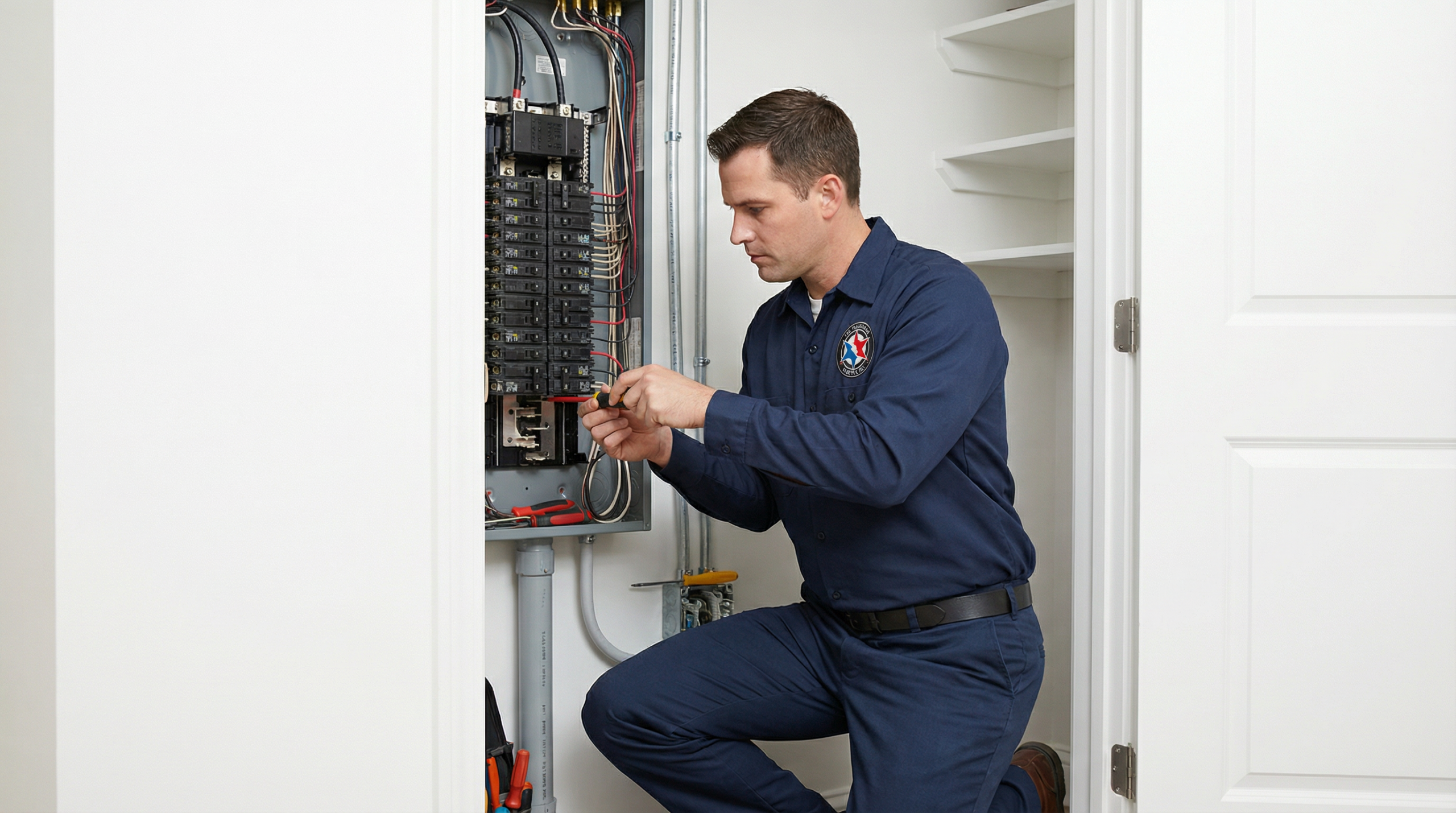
On installation day, a licensed electrician arrives at the unit in the morning. Power is shut off by 8:00 AM. The old panel is carefully removed and the new one is mounted in the same location. The electrician connects all existing electrical circuits to the new equipment, traces and labels every circuit — controlling lights, outlets, appliances, HVAC, and other loads. Installing the new breakers for each circuit is done one at a time to ensure nothing is missed. Every lighting circuit, every outlet, every dedicated appliance circuit — for accuracy, and installs modern safety devices including AFCI arc-fault and GFCI ground-fault breakers where required by current code.
New grounding and bonding connections are installed to meet National Electrical Code requirements, including UFER grounding where applicable. Note that the NEC requires a minimum workspace of 30 inches wide to be maintained in front of the panel — a requirement inspectors verify on every installation. New electrical panels must include modern safety components such as ground rods and surge protection to protect sensitive electronics and ensure reliable electrical systems throughout the community.
The new panel is rated for 200-amp service, providing the capacity the community needs for modern electrical load demands including EV chargers, solar installations, and high-draw appliances. A city inspector verifies the work before power is restored, typically by 5:00 PM the same day. Lights, outlets, appliances, and HVAC are off from 8 AM and restored by 5 PM — including heat in colder months, which is why scheduling communication matters. Gas service is not interrupted; only the electrical service is shut off during the installation window. Each address requires one day of work. No overnight outage. No displacement required. If stucco or siding was disturbed during the work, repair and paint matching are completed as part of the service.
California homeowners and HOA communities must follow both HOA rules and state regulations, including the California Electrical Code (CEC), when installing or replacing panels. The plans for installing new panels must be approved by the local building department before work begins — installing panels without approved plans and permits creates disclosure and liability risks that fall on the board and individual homeowners. Professional installation by a licensed C-10 electrician ensures compliance with both. Homeowners must ensure that any tenant-installed electrical work also follows HOA rules and California codes to avoid fines or liability. A licensed electrician must perform all panel work and provide a report confirming compliance with safety standards — inspections are required for verifying that the work meets the California Electrical Code and remains insurable.
Throughout the installation phase, board members receive Friday status reports with a full update on addresses finished, addresses scheduled, outstanding access issues, and overall progress. At Lakeglen HOA, these weekly reports allowed the board to maintain confident oversight of a 129-unit engagement without having to manage day-to-day logistics themselves. The board made decisions. The coordinator managed execution. The reports kept both aligned.
Step 19: City Inspector Sign-Offs Per Unit
Every finished address receives a city inspection sign-off before the work is considered done at that location. The signed permits and inspection records become part of the records package for that home — confirming code-compliant professional installation to the insurer, protecting the homeowner at resale, and creating a permanent record for the association’s maintenance history. Approved permits at each address are essential for insurance reinstatement and future compliance reviews.
Phase 7: Closeout and Records (Step 20)
Step 20: Final Documentation Package to Carrier
The final step is the one that closes the insurance loop. A complete records package is assembled for the carrier: permit copies for every address, inspection sign-offs, contractor certification, warranty documentation, and a compliance letter confirming that all identified panels have been replaced with code-compliant equipment. This package is what transforms the finished work into insurance reinstatement.
Boards should retain a complete copy of this records package permanently. It will be referenced in future insurance renewals, homeowner resale disclosures under SB 382, and any future audits of the community’s maintenance history. The results of each inspection help determine policy eligibility and support accurate premium calculation going forward.
The Lakeglen HOA Case Study: Proactive Planning at Scale
Lakeglen HOA is a 129-unit condominium community in Orange County with a mix of panel types from original construction. The engagement illustrates how a complex community-wide replacement succeeds when the process is managed correctly — and how much the proactive approach changes the experience for everyone involved.
The Lakeglen board did not wait for an insurance ultimatum. Their property manager raised concerns proactively, before any non-renewal notice was received. The board commissioned a professional inspection and discovered widespread Federal Pacific and Zinsco panels throughout the community. Their broker confirmed what the inspection suggested: these panels would be a problem at the next renewal.
The board voted to act before receiving any ultimatum from the carrier. They selected Tradesman Electric based on HOA-specific experience and management infrastructure.
The work was more complex than a typical 129-unit engagement. More than 80 homes required access box modifications in addition to the panel replacements themselves. Off-site owners who rented their homes required multiple contact attempts through different channels. Tenant schedules had to be coordinated alongside owner notifications. SCE coordination added complexity that had to be built into the plan from the beginning.
What made it work despite this complexity was the infrastructure behind it. Friday status reports kept the board informed of progress without requiring board members to manage logistics themselves. Monday.com tracking gave real-time visibility into which addresses were done, which were scheduled, and which still needed follow-up. A dedicated coordinator handled homeowner communication, rescheduling, and inspector coordination. The board made policy decisions. The firm managed execution.
The work was finished before the insurance renewal date. The board never received a non-renewal notice because the issue had already been addressed. Insurance was renewed at standard market rates without the premium penalty that communities receiving cancellation notices typically experience.
[Board member testimonial — placeholder for quote from Lakeglen board]
Compare that to Dana Bluffs HOA, a smaller Orange County community with original FPE panels that did not act until their insurance agent appeared at a board meeting with a warning — followed shortly after by a formal non-renewal notice with a 90-day compliance window. The board acted quickly and the work was done within the deadline, but the experience was stressful, the timeline left no margin for error, and every decision was made under pressure that proactive action would have eliminated entirely.
Both communities ended up with the same outcome: new panels, maintained insurance, protected property values. The difference was entirely in how they got there.
What Separates a Specialist from a General Electrician
This is the question boards most often ask after understanding the scope: What kind of firm can actually handle this?
The answer matters because the wrong choice creates its own crisis. A general electrician who handles individual service calls has no infrastructure for managing a 100-unit engagement. No dedicated coordinator. No warehouse for pre-procurement. No tracking software. No experience with HOA homeowner communication, permit coordination across dozens of addresses, or SCE utility liaison. They may produce excellent work on individual homes while failing completely at management — and management failure at this scale means missed carrier deadlines, incomplete records, and permit complications that affect every homeowner. Confusing project management complexity with standard residential service work is the mistake boards most commonly make.
Replacing an electrical panel in an HOA property requires professional, licensed electrical work to ensure safety and code compliance. Every customer deserves a contractor whose qualifications match the complexity of the work. The qualifications that matter for a community-wide HOA electrical panel replacement engagement:
• 100-plus HOA electrical systems upgrades completed. Our customer base includes communities from 50 to 500 units across Orange County, and every customer relationship is built on the same structured process. Not 100 individual replacements — 100 community-wide engagements with multi unit HOA-specific complexity.
• Dedicated coordinator. A full-time administrator who manages homeowner communication, scheduling, permit tracking, and inspector coordination for your community specifically.
• Tracking software. Real-time visibility that the board can access, with structured reporting that keeps oversight possible without micromanagement.
• Warehouse capacity. The ability to pre-procure and store all materials before installation begins, eliminating supply chain risk.
• Crew size and composition. A dedicated crew large enough to maintain installation pace across a community-sized engagement without subcontracting key work.
• Written workmanship warranty. Every customer receives a 20-year written warranty — not a handshake, a signed document. When customers have questions about their warranty years later, we answer them. That is what it means to be accountable to our customers. Not a verbal guarantee — a written warranty that protects every homeowner whose home was part of the work.
• Insurance records expertise. The ability to produce the complete carrier package that restores standard-market coverage at completion.
The Board’s Responsibilities Throughout the Engagement
One of the most common misconceptions boards have going into a community-wide panel replacement is that they will need to manage it closely. With the right firm, the opposite is true.
The board’s responsibilities in a well-managed engagement are decision-making and oversight — not logistics. The board approves the work, selects the firm, determines the funding structure, communicates with homeowners about why upgrading electrical systems is necessary, and receives regular progress reports. The firm manages execution. Every customer we work with — from small 50-unit communities to large 500-unit developments — experiences this same division of responsibilities. Our customers are never left managing logistics that should be the contractor’s job. We measure our success by how well our customers sleep at night during a stressful compliance process. When our customers tell us the project ran smoothly, that is the standard we hold ourselves to. Customer feedback drives how we refine the process, and every customer engagement makes the next one better.
This division of responsibilities is what made Lakeglen work. The board was never overwhelmed by logistics because the coordinator was handling them. The board was never out of the loop because the weekly reports provided consistent visibility. And the board was never surprised because the process was structured to surface issues before they became problems or disputes.
Property managers play a facilitation role — helping coordinate homeowner communication, providing contact information, and supporting the scheduling and coordination process. But the fiduciary responsibilities for the work rest with the board. Property managers advise. Board members decide. That distinction matters in California law.
Safety Standards Every Board Should Understand
Safety is a top priority in California HOAs, and understanding the standards that apply to electrical systems upgrading helps boards set expectations and evaluate the quality of the work being done.
• Electrical systems in HOA communities must comply with both the National Electrical Code (NEC) and the California Electrical Code (CEC), as well as any HOA-specific appearance requirements for conduit colors and enclosure finishes.
• New panels must include modern safety components such as ground rods, surge protection, AFCI arc-fault breakers, and GFCI ground-fault breakers in required locations. These are not optional — they are required by current code and essential for reliable electrical systems.
• The NEC requires a minimum workspace of 30 inches wide in front of every panel to ensure safe access for inspections and future maintenance.
• Multi-meter electrical panels must meet strict electrical codes and utility company requirements. This is especially important in multi unit construction where shared meter configurations are common.
• Proper grounding and bonding eliminate safety hazards from electrical faults and protect residents from shock and fire risks.
• Following HOA guidelines and state requirements ensures compliance, safety, and community harmony. Homeowners must follow safety standards to reduce risk and ensure reliable electrical systems. Failure to comply in accordance with these standards can lead to fines, correction orders, and removal of work.
Your Next Step
The 20-step process described in this article is exactly what Tradesman Electric executes on every community-wide HOA engagement. The process is the product — because consistent execution across dozens or hundreds of homes, with complete records and zero-lapse insurance outcomes, requires a structured approach that cannot be improvised. Our customers benefit from that structure from the first conversation to the final permit sign-off. Every customer signs a written contract before work begins. Customers deserve to know exactly what they are getting that spells out scope, timeline, warranty terms, and the documentation package we commit to delivering. Our customers never wonder what they agreed to — it is in writing, and we stand behind it.
The first step costs nothing, and it comes with no strings attached. Our customers are not pressured into decisions. Customer satisfaction — not just compliance — is the goal. When customers call with questions six months after the job is done, we pick up the phone — they receive accurate information and make their own choices. When customers are ready to move forward, we are ready to execute. When customers need more time, we are here to answer questions. That is how we have built our customer base in Orange County for 35 years. Schedule a free community-wide panel assessment — the same evaluation we provide to every customer and within 48 hours your board has a complete written report with photo records of every panel in the community. No obligation. No pressure. Just accurate information so your board can make a sound decision.
Tradesman Electric: (949) 978-0535 | www.thetradesmanelectric.com
Licensed (C-10 #1049948) • Insured • Established 1991. Serving Orange County and surrounding areas since 1991. 1,000+ panels replaced annually. 12-person dedicated crew. 3,000 sq ft warehouse. 20-year written workmanship warranty.
Sources and References
• Davis-Stirling Common Interest Development Act: Civil Code Sections 4000–6150, including Section 4775 (maintenance duties) and Sections 5500–5510 (fiduciary duties)
• California Legislative Information: SB 382 (Becker, Chapter 443, Statutes of 2024), adding Civil Code Sections 1102.6i and 1102.6j
• Consumer Product Safety Commission: Investigation of Federal Pacific Electric panels (1980–1983), closed without reaching a definitive safety determination
• Dr. Jesse Aronstein: Independent testing of FPE Stab-Lok breakers documenting 60–70% failure rates during overcurrent conditions
• National Electrical Code: AFCI and GFCI requirements; minimum 30-inch workspace requirement for panel installations
• California Department of Insurance: 75-day minimum non-renewal notice requirement for homeowner policies
• Southern California Edison: Meter spot request procedures and lead time requirements for panel replacement work
For more electrical safety guides, visit the Tradesman Electric blog.